
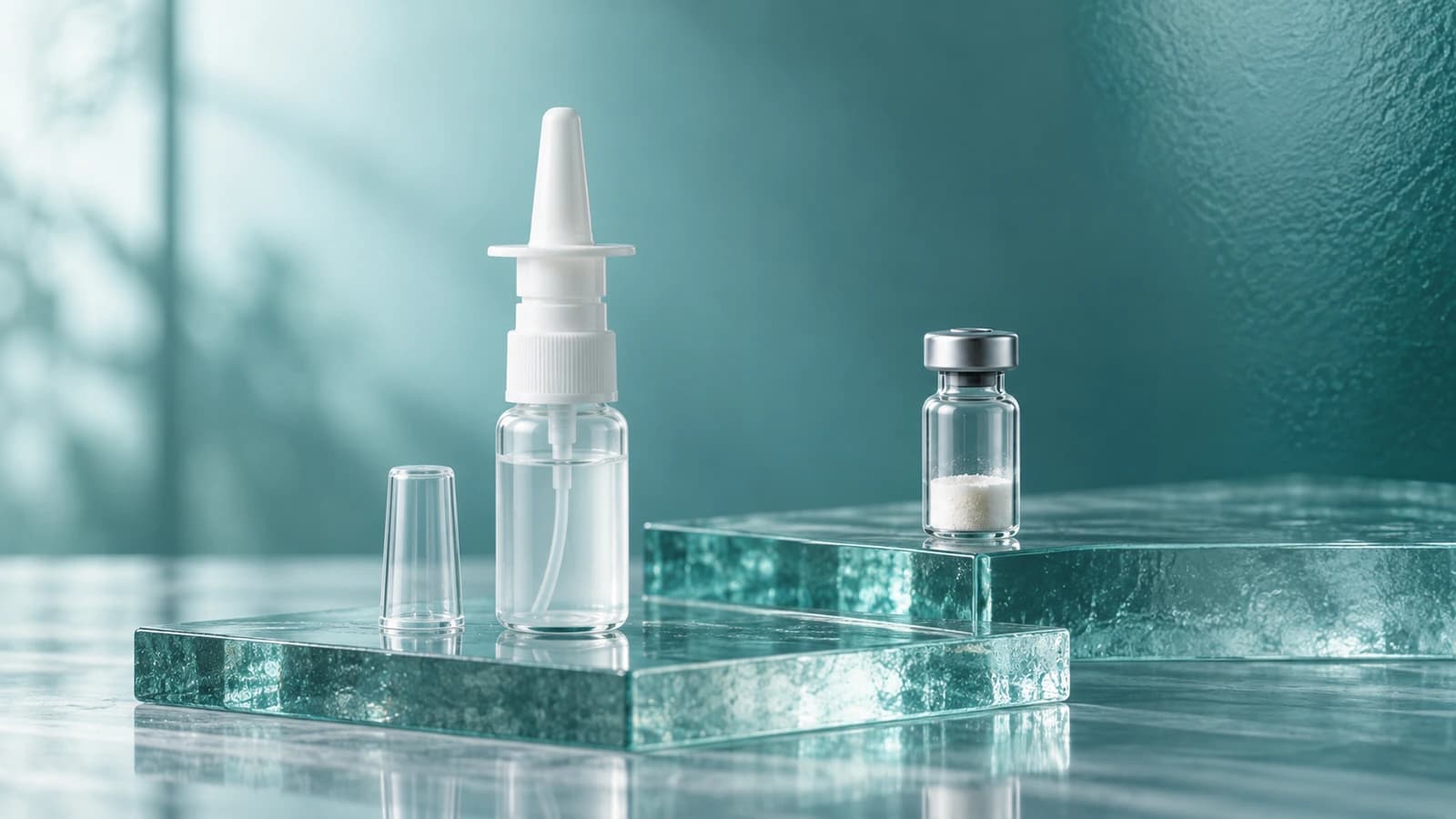
Premixed Semax Nasal Spray vs. Lyophilized Semax: Which Shelf-Life Claims Belong to Each Product Format?
In this article
When evaluating synthetic nootropic and neuroregulatory peptides like Semax (heptapeptide Pro-Gly-Pro-Glu-His-Pro-Gly, molecular weight ~712.8 Da), buyers across clinical practices, aesthetic studios, research laboratories, and distribution channels frequently encounter conflicting stability metrics. Online forums routinely cite a universal 14- to 28-day expiration window, creating confusion between raw lyophilized material, home-reconstituted research vials, and pharmaceutical-grade premixed nasal spray assemblies.
Parsing these claims requires separating raw molecular degradation kinetics from microbial breach risks in multi-use delivery systems.
Defining the Two Formats
1. Lyophilized Semax (Vial Form)
- State: Freeze-dried cake or powder sealed under vacuum or inert gas atmosphere.
- Primary Utility: Maximum long-term chemical preservation, custom concentration dosing, and extended cold-chain storage prior to deployment.
- Reconstitution Requirement: Typically dissolved in bacteriostatic water (0.9% benzyl alcohol) or sterile saline immediately prior to active application windows.
2. Premixed Semax Nasal Spray
- State: Liquid solution packaged in metered-dose nasal spray actuators with calibrated droplet output (typically 30–50 µm particle distribution for optimal olfactory and respiratory epithelial absorption).
- Primary Utility: Plug-and-play consistency, eliminated manual reconstitution error, standard per-actuation dosage (e.g., 100 mcg–200 mcg per spray), and integrated multi-dose preservative matrices.
Dissecting the Shelf-Life Claims
Swipe or scroll to compare all columns.
| Parameter | Lyophilized Semax (Sealed Powder) | Reconstituted Semax (From Lyophilized + Bac Water) | Premixed Commercial Nasal Spray (Sealed) | In-Use Premixed Spray (Opened / Actuated) |
|---|---|---|---|---|
| Unopened Storage | 24–36 months (-20°C) / 12 months (2–8°C) | N/A (Must be prepared) | 12–24 months (2–8°C) | N/A |
| Active In-Use Life | N/A | 14–28 days (refrigerated 2–8°C) | N/A | 30–60 days (controlled cool environment) |
| Primary Degradation Vector | Moisture ingress, thermal peptide bond cleavage | Deamidation, oxidation, bacterial/fungal inoculation | Preservative exhaustion, pump actuator micro-leakage | Microbial bioburden accumulation, tip contamination |
| Primary Expiration Driver | Chemical purity assay drop below specs | Microbial safety threshold + potency decay | Manufacturer stability validation limit | Repeated atmospheric/nasal micro-reflux exposure |
Where the "14–28 Day Rule" Originates
The oft-repeated 14-to-28-day limitation does not reflect native chemical destruction of Semax at day 15. Instead, it derives from clinical safety guidelines for multi-use preservative-containing or bacteriostatic water-reconstituted nasal/injectable formats where repeated needle punctures or nasal actuator backflow introduce micro-organisms. Benzyl alcohol in standard bacteriostatic water suppresses bacterial proliferation for roughly 3 to 4 weeks under strict 2–8°C cold chain discipline; beyond that window, compounding risk profile shifts toward biological contamination rather than peptide collapse.
Why Lyophilized Powder Behaves Differently
In the freeze-dried solid state, water activity (aw) is near zero, suppressing hydrolytic cleavage and enzymatic degradation pathways. Stored at -20°C or shielded from UV/thermal cycling, certified-pure peptide cake retains high assay integrity (>98% HPLC purity) for years.
Why Industrial Premixed Sprays Extend Metrics
Cleanroom-filled, pharmaceutical-grade premixed sprays utilize validated preservative systems (such as controlled parabens or quaternary ammonium/chlorobutanol blends depending on regulatory tier) or closed-system collapse-bag reservoirs that prevent ambient air return. Consequently, unopened shelf-life spans 12–24 months under refrigeration, while active functional windows extend past standard 28-day home-mix thresholds safely up to the validated mechanical seal limit.
Molecular Size, Bioavailability, and Delivery Realities
A common point of skepticism in peptide forums is whether molecular weight governs nasal viability. Semax features a molecular mass of ~712.8 Da—well below the 1,000–3,000 Da threshold typically posing mucosal permeation hurdles without permeation enhancers.
- Absorption Pathway: Intranasal delivery bypasses first-pass hepatic metabolism, granting rapid systemic and direct central nervous system translocation via the olfactory and trigeminal neural pathways.
- Droplet Physics: Droplets exceeding 100 µm deposit in the anterior nasal vestibule, leading to poor systemic uptake. Precision metered spray actuators delivering 30–50 µm aerosols maximize respiratory/olfactory mucosal surface contact regardless of whether the vehicle originated from a cleanroom premix or fresh reconstitution.
Operational Guidelines for Clinics, Resellers, and Researchers
- Verify Lot-Specific COAs: Never trust blanket stability timelines without independent HPLC purity and endotoxin/bioburden verification. Review batch data via Biopepgen COA Verification.
- Cold-Chain Discipline: Exposing reconstituted or liquid premixed Semax to ambient room temperature (>25°C) for extended durations accelerates peptide conformation drift. Maintain 2–8°C storage.
- Format Selection Strategy:
- Research & Custom Titration: Opt for Lyophilized Semax paired with precision diluent calculation.
- Clinical Efficiency & Patient/Client Compliance: Standardize on verified-batch premixed delivery assemblies or custom white-label runs via Bulk & Private Label Solutions.
Exploring Complementary Neuro-Regulatory and Metabolic Research Portfolios
Peptide integration protocols frequently span parallel metabolic and regulatory research axes. Explore adjacent validated catalog profiles:
- Cognitive and neuro-trophic modulation: Selank
- Metabolic and receptor-agonist validation: Tirzepatide and Semaglutide
- Full spectrum exploratory compounds: Biopepgen Catalog
For specialized multi-sequence synthesis requirements or custom formulation parameters, consult Custom Peptide Synthesis or review quality assurance protocols at Quality Control Overview.
Sourcing and Consultation Directives
Whether structuring high-volume commercial distribution, aesthetic clinic inventories, or investigator-led assay pipelines, direct engagement ensures proper batch traceability:
- Request formal pricing tiers or institutional allocations: Request Quote
- Direct technical inquiry or batch specification dialogue: Sales Support Chat or Contact Page